Robots vs. Augmented Reality: The Next Surgical Arms Race?
Surgical technology is evolving at a pace the industry hasn’t seen in decades. Hospitals, surgeons, and MedTech manufacturers are navigating a rapidly expanding landscape of digital tools—each promising to redefine standards of precision, efficiency, and patient care. Two innovations now dominate that conversation: robotic-assisted surgery and augmented reality (AR) navigation.

From Novelty to Necessity: How Robotics Took Over the Conversation
Surgical robotics entered the market in the early 2000s with bold promises of greater accuracy, enhanced control, and increased consistency, creating an entirely new paradigm for minimally invasive procedures. For years, ground-breaking companies like Intuitive, Think Surgical, and MAKO shaped the robotics narrative while the industry watched closely to see if robotics would truly take hold.
Then came the MAKO acquisition in 2013.
When Stryker acquired MAKO, it didn’t just validate robotics in orthopedics – it triggered a full-scale competitive arms race across ortho, spine, and beyond. Overnight, MedTech strategy decks everywhere added a new slide:
“What’s our robotics strategy?”
R&D programs pivoted, capital flowed aggressively toward platform development, and OEM portfolios reorganized around the promise of mechanical precision and platform economics. Robotics had become more than a tool—it was a market signal of technological leadership.
A New Front Emerges: The Rise of AR-Navigated Surgery
Fast-forward to today. Augmented reality is emerging as a transformative force in the OR. Instead of requiring a robotic arm between surgeon and patient, AR projects 3D anatomy, trajectories, implant profiles, and navigational cues into the surgeon’s field of view, offering guidance and precision without interrupting tactile control.
Where robotics promises mechanical perfection, AR promises immersive visualization, workflow flexibility, and greater accessibility to advanced guided surgery.
Both technologies aim to increase accuracy and improve outcomes, but their strengths – and their limitations – are fundamentally different. Understanding those differences is key to developing a winning MedTech portfolio strategy.
Robotic Surgery: High Precision, High Differentiation, High Cost
Robotics continues to dominate headlines, capital budgets, and the strategic roadmaps of category leaders. For OEMs, robots offer a defensible platform model with long-tail revenue streams tied to implants, disposables, instruments, and service.
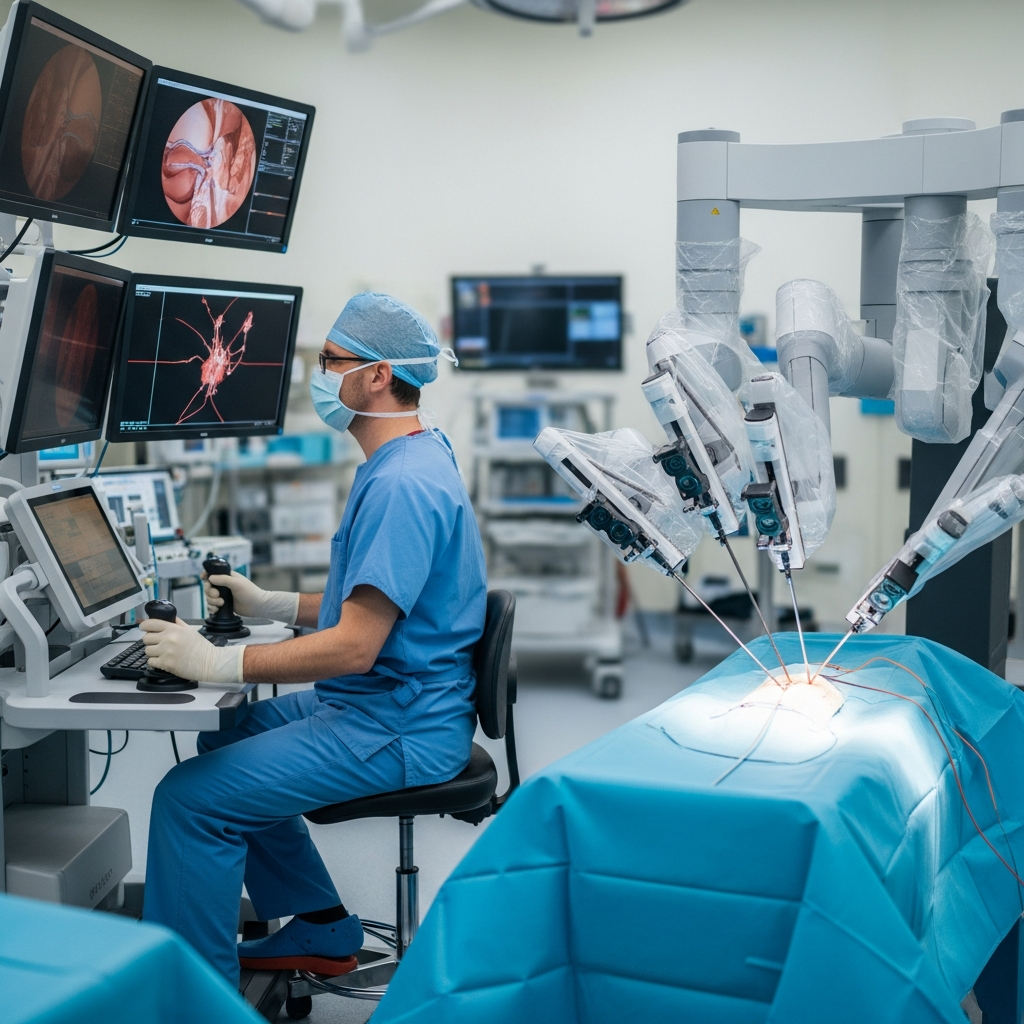
Strategic Advantages of Robotics
Mechanical precision and stability
Robots eliminate hand tremors, enable micro-movements, and enforce rigid trajectories that humans simply can't replicate.Reproducibility / consistency
Robotics minimizes procedural variability and enables standardization critical for scaling quality across systems with predictable patient outcomes.Prestige and market pull
“We have a robot” remains a powerful marketing message for hospitals recruiting surgeons and attracting patients.Platform defensibility
Robots create durable switching costs. Once installed, institutions are locked into an OEM ecosystem – although open platform robot systems may disrupt this effect.Data pipeline foundation
Robots generate structured, high-fidelity, intraoperative data which can be used for predictive analytics, automation, and personalization.
Limitations Where Robotics Struggles
Large capital burden
Multimillion-dollar systems with service contracts, disposable requirements, and dedicated infrastructure requirements slow sales cycles and restrict penetration into ASCs and mid-tier hospitals.Workflow disruption
Setup, draping, calibration, and footprint challenges add time, reduce OR flexibility, and irritate staff.Scaling complexity
High development and capital costs make expansion into new workflows and low-volume procedures economically impractical.Steep adoption curve
Surgeons must adapt to console-based workflows, reduced tactile feedback, and mechanized execution.Maintenance dependency
Robots require specialized service teams, creating bottlenecks when equipment needs preventive maintenance or malfunctions.
For established MedTech companies, robotics is a powerful – but capital-intensive – platform play that thrives in high-volume centers.
AR-Navigated Surgery: Accuracy Meets Accessibility
AR systems overlay digital intelligence directly into the surgeon’s field of view as a guide rather than physically driving surgical steps. This information guidance approach fundamentally shifts the balance between cost, workflow impact, and precision.
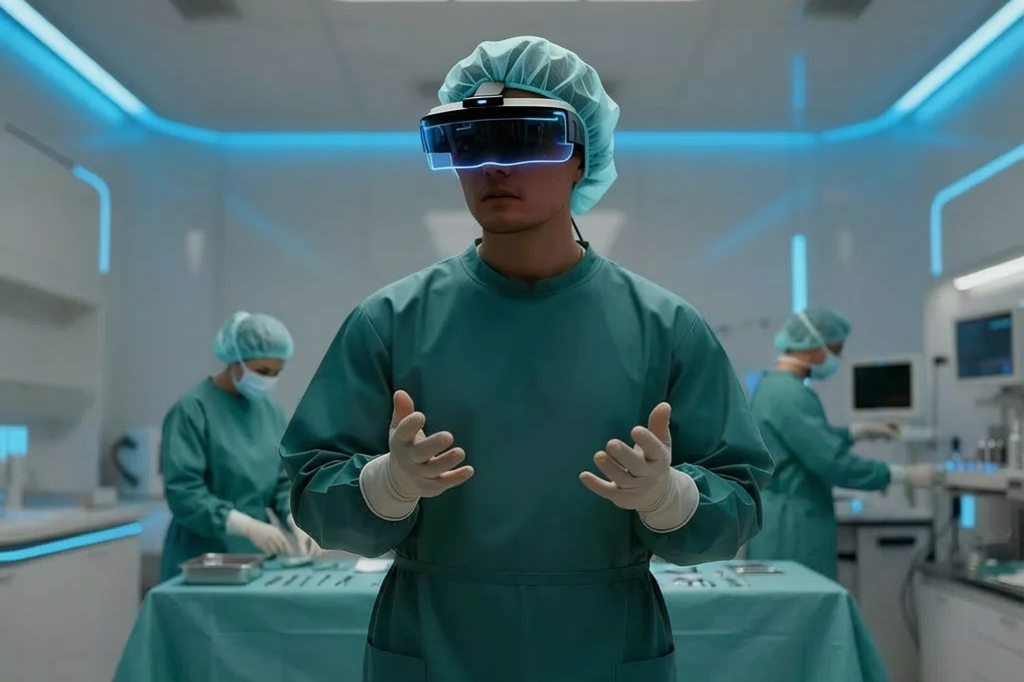
Strategic Advantages of AR Navigation
Order-of-magnitude lower capital cost
AR leverages off-the-shelf headsets and software-driven instrumentation, dramatically reducing purchase barriers.Minimal workflow disruption
Lightweight hardware integrates cleanly into existing OR setups, enabling fast adoption and consistent use.Scalable across procedures
A software-first architecture allows rapid development iteration and expansion into lower-volume procedures.Preserved tactile feedback
Surgeons maintain full control and natural dexterity which is critical for some surgical maneuvers.More intuitive visualization
Heads-up overlays keep the surgeon attention on the patient, not on a console monitor.Flexible OR utilization
Multiple headsets can be deployed across OR’s without infrastructure constraints.
Limitations Where AR Struggles
Precision and mechanical control
AR systems provide digital/visual guidance for surgical steps rather than physical control. Human variability remains, and accuracy is also tied to tracking quality and instrument design.Market perception gap
AR is still associated with consumer tech, and confusion with VR weakens its perceived sophistication.Tracking vulnerabilities
Line-of-sight disruptions can interrupt guidance when the surgeon looks away from the surgical table. Some innovative glasses address this issue, like Magic Leap, but this technology is still developing.Fatigue challenges
Headset weight and visual strain can lead to ergonomic and cognitive fatigue.Lower platform defensibility
Lower cost means hospitals can more easily switch vendors, pressuring OEM differentiation.Limited long-term data
While early AR results are promising, robotics has a 15–20 year head start in clinical validation.
For MedTech leaders, AR is a high-growth adjacency with a broad total addressable market, particularly where costs are heavily constrained.
Where the Market Is Heading: Hybrid Thinking Wins
A binary debate misses the point. The future isn’t robotics versus AR—it’s the convergence of precision, visualization, scalability, and data into unified surgical ecosystems.
Four Market Forces Shaping the Next Decade
Capital budgets are tightening—value engineering wins.
Robotics isn’t going away, but the days of unlimited capital spending are over. AR directly benefits from this shift.Surgeon expectations are evolving.
Robot system OEM’s have invested heavily in training the next generation of surgeons on their systems to improve the robot adoption curve. However, surgeons will always be looking for new ways to enhance their capabilities with new technology.Data is the ultimate battleground.
Robotics systems collect higher-fidelity data during the procedure. The winners will be companies that fuse these data streams into predictive, personalized, and automated surgical intelligence.TAM expansion with under-served ORs.
ASCs, mid-volume hospitals, and international markets have been priced out of robotics. AR opens the door to lower-volume procedures and a far larger market.
The Takeaway: It’s a Portfolio Strategy
The MedTech industry has spent the last decade locked in a robotics arms race. Now, with AR accelerating into clinical relevance, a new competitive front has opened. But the real takeaway isn’t who wins the fight; it’s that victory requires both.
Robotics delivers unmatched precision, market defensibility, and reproducibility, making it best suited for large hospitals and high-volume procedures such as spinal fusions and joint replacement. AR delivers economic accessibility, flexibility, and scalability, optimizing for small to mid-size hospitals and ASC’s with lower case volumes and for lower-volume procedures.
The companies that lead the next era of surgical technology will be the ones who offer both platforms and create a surgical ecosystem that:
Blends robotic control with AR accessibility
Builds data streams that improve future procedures
Meets the financial realities hospitals face today
Open-platform robotics from companies like Think Surgical already shows how OEMs can bypass years of capital-intensive development and focus on differentiated value in: AR, software, user experience, visualization, automation, and surgical intelligence. And if open-platform robotics is now possible, an open-platform AR ecosystem is the logical next step.
In the end, the winners in surgical technology won’t be defined by the size of their robot or the novelty of their AR headset. They’ll be defined by how seamlessly they merge precision, visualization, automation, and data into a surgeon-first workflow that scales globally.
Sorry sci-fi fans – this isn’t a robot war.
It’s the next evolution of surgical technology – and it’s only the beginning.
Contact Factor 7 Medical to learn more on how our experts can partner with you to cut through the hype with Robotics and AR!
Related Resources